Plenty of companies have a successful AI pilot. Far fewer have AI in production. Here’s how to cross the gap — without breaking the business.
By Cedric Thomas, CEO · Strategy Planning Execution · cthomas@spxltd.com
By now, a lot of mid-market companies have a win to point to: an AI pilot that worked. An agent that handled reconciliations, answered a set of Tier 1 customer inquiries, drafted the first pass of a report, or cleared a backlog nobody had time for. The demo impressed, the numbers looked good, everyone got excited.
Then the initiative stalls. The pilot never quite becomes production. It runs in a corner, on one process, for one team, while the promised transformation stays perpetually six months away.
This is the most common place for agentic AI to die in the mid-market: not in the pilot, but in the gap between a pilot that works and a system you can actually run the business on. This guide is about crossing that gap on purpose..
Why pilots succeed and production doesn’t
A pilot is a controlled environment, and that’s the whole point of it. One process. Curated data. Close human supervision. Forgiving stakes. A hand-picked, enthusiastic team. Under those conditions, modern AI performs beautifully. Production is the opposite of every one of those conditions. Full volume, with all the weird edge cases the pilot never saw. Live, messy data from systems that don’t always agree. Little or no supervision. Real stakes. And the whole team — including the people who never asked for this.
A pilot proves the agent can work. Production proves it keeps working.
So the uncomfortable truth is that the things that made your pilot succeed are exactly the things production takes away. Crossing the gap isn’t about a better model. It’s about rebuilding those conditions — deliberately — for the real world.
The five things that break when you scale
1. Volume and edge cases. Your pilot saw the happy path — the clean 80%. Production is where the messy 20% lives: the malformed input, the exception nobody documented, the once-a-quarter scenario. At scale, the edge cases stop being edge cases; they become a daily flood, and an AI agent that guesses on them does damage fast.
2. Data and integration. The pilot ran on data someone cleaned by hand. Production needs live data flowing reliably from the systems where work actually happens — and that data is messier, later, and more contradictory than the pilot set. Most scaling problems are really data problems in disguise. AI does not consistently work without clean data sets and a working data governance model.
3. Governance and control. A supervised pilot becomes an unsupervised fleet. Now you need guardrails, an audit trail, clear decision rights, monitoring, and a way to catch a misbehaving agent before it does something expensive. Governance felt like overhead in the pilot; in production it’s what keeps you out of the headlines.
4. Adoption and trust. Your pilot had volunteers. Production has everyone — including the skeptics, the people whose jobs are changing, and the ones with a workaround they like better. Without deliberate change management and a drive to optimize adoption, a technically successful rollout quietly goes unused.
5. Economics. A great ROI on one process doesn’t automatically hold across fifty. Watch the unit economics — the per-transaction cost of tokens, licenses, and oversight — and be honest about which processes actually justify the spend at scale. Some pilots should stay pilots.
A staged path from pilot to production
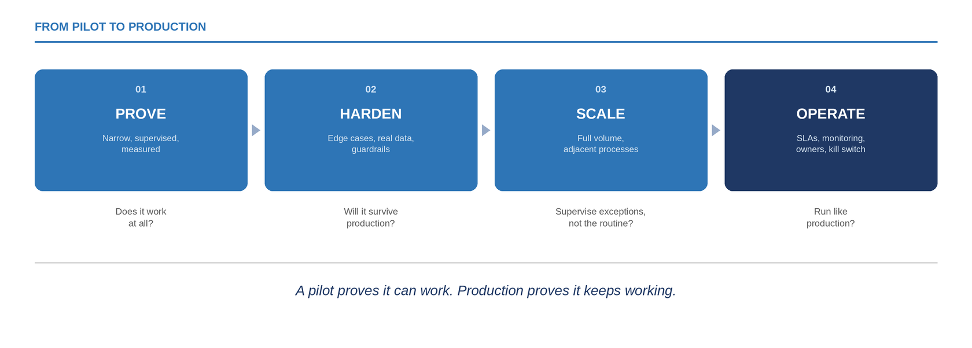
We take agentic AI up the same four stages, each with a gate you don’t skip:
Prove. The pilot — narrow, supervised, measured. Gate: does it work at all?
Harden. Before you scale anything, handle the edge cases, wire in the real data, add the guardrails and monitoring, and define exactly what counts as an exception and who it escalates to. Gate: will it survive production?
Scale. Expand to full volume and adjacent processes — deliberately, in increments, with humans supervising the exceptions rather than the routine. Gate: can we supervise by exception, not by transaction?
Operate. Run it like production: SLAs, monitoring, named owners, continuous improvement, and a kill switch. Gate: is this actually being operated, or just left running?
Most stalled initiatives are stuck trying to jump straight from Prove to Scale, skipping the unglamorous Harden stage entirely. That’s the stage that decides whether production breaks.
The gate every pilot must pass before production
Before you scale, make the pilot earn it. It should hold up on the edge cases, on real production data, with guardrails in place, with the skeptics using it, and at a unit cost that still makes sense at volume. If it can’t clear that gate, scaling doesn’t spread the success — it multiplies the risk. A pilot that fails the gate isn’t a failure; it’s telling you precisely what to fix before you bet operations on it.
How to scale without breaking operations
A few rules keep the business standing while you scale:
Run in parallel first. Let the agent work alongside the current process for a cycle or two and compare the outputs line by line — so trust is earned on evidence, not faith.
Keep a human in the loop — and a kill switch. Someone owns the agent, reviews the exceptions, and can stop it instantly if it starts to drift.
Scale in increments, not a big bang. One process, one region, one team at a time — each increment a small, reversible bet rather than a company-wide gamble.
Monitor from day one. Track accuracy, exception rates, and drift so you catch problems before your customers do.
Keep the fallback alive. Don’t retire the old path until the new one has proven itself under real production load.
The goal isn’t to scale fast. It’s to scale without ever putting the core operation at risk.
What this means for your team
One more shift is worth naming, because it’s where scaling quietly succeeds or fails: what your people actually do changes at every stage. In Prove, a few enthusiasts babysit the agent. In Harden, your best process people define the exceptions and guardrails — expert work, not grunt work. In Scale, the team stops doing the routine and starts supervising by exception, which is a genuinely different job that needs training and reassurance. And in Operate, someone owns the agent the way they’d own any other critical system.
Miss these steps, and you get the most common and most expensive outcome in enterprise AI: a rollout that technically works and that the organization never actually adopts. The model was never the hard part. The people were.
Frequently asked questions
Why do AI pilots fail to reach production?
AI pilots fail to reach production because production removes everything that made the pilot easy: it brings full volume and edge cases, live and messy data, little supervision, real stakes, and the whole team rather than a hand-picked few. Pilots that aren’t deliberately hardened for those conditions stall.
How long does it take to go from pilot to production?
It depends far more on your data, governance, and change readiness than on the AI itself. Teams that treat “harden” as a real stage tend to move faster overall, because they don’t have to walk back a rollout that broke.
What’s the biggest risk in scaling agentic AI?
Unsupervised errors at scale. One agent making a bad call under supervision is a learning moment; a fleet making bad calls unsupervised is an operational and reputational problem. Governance, monitoring, and a kill switch are what contain it.
Should we scale a pilot just because the ROI was good?
Only if it passes the scale gate. Pilot ROI on one clean process rarely predicts production ROI across many messy ones. Confirm the edge cases, the data, the governance, the adoption, and the unit economics first.
Have a pilot that worked but hasn’t scaled?
SPX helps mid-market companies take agentic AI from pilot to production — hardening the process, data, and governance so it holds up under real load, and scaling without putting operations at risk.
→ Book a scale-readiness assessment with SPX.
Cedric Thomas, CEO · cthomas@spxltd.com · spxltd.com