
Why most AI projects fail on readiness, not technology — and the five dimensions to check before you deploy agents.
By Cedric Thomas, CEO · Strategy Planning Execution · cthomas@spxltd.com
AI agents are the most exciting thing to hit mid-market operations in a decade, and the easiest to get wrong. The pattern is familiar: a leadership team sees a compelling demo, buys a tool or commissions an agent, points it at a real workflow — and watches it stall. The instinct afterward is to blame the technology. Usually, the technology was fine. The operation wasn’t ready for it.
AI readiness is the difference between an agent that quietly compounds value and one that becomes an expensive science project. And readiness has almost nothing to do with the model you choose. It has everything to do with the environment you drop it into: your processes, your data, your systems, your controls, and your people.
This is a practical readiness assessment for mid-market companies — the five dimensions to check before you deploy AI agents into your operations, and the honest questions to ask of each.
What does “AI-ready” actually mean?
Being AI-ready means your operation can hand a task to an AI agent and trust the result — because the process is standardized, the data is clean, the systems are connected, the work is governed, and your people are prepared to use it.
It is not a measure of how advanced your AI is. A company with no AI at all can be highly ready; a company that has bought every tool on the market can be deeply unready. Readiness is about the conditions surrounding the agent, not the agent itself — which is exactly why it gets overlooked in the rush to deploy.
Why AI projects fail on readiness, not the model
Today’s models are remarkably capable out of the box. That is precisely what makes readiness the real constraint: when the model is rarely the weak link, the weak link is everything around it. An agent dropped onto an improvised process will produce inconsistent results, because there was no consistent process to begin with. An agent reasoning over messy data will produce confident, well-formatted errors. An agent with no ability to act in your systems can only advise. And an agent no one trusts will be quietly ignored.
The model is rarely the problem. The environment you drop it into is.
So before you evaluate vendors or write a single prompt, evaluate yourself. The assessment below is the one we run with mid-market teams.
The AI readiness assessment: 5 dimensions
Score your operation honestly across five dimensions. Each has a single diagnostic question; a weak answer anywhere is where your AI deployment will struggle first.
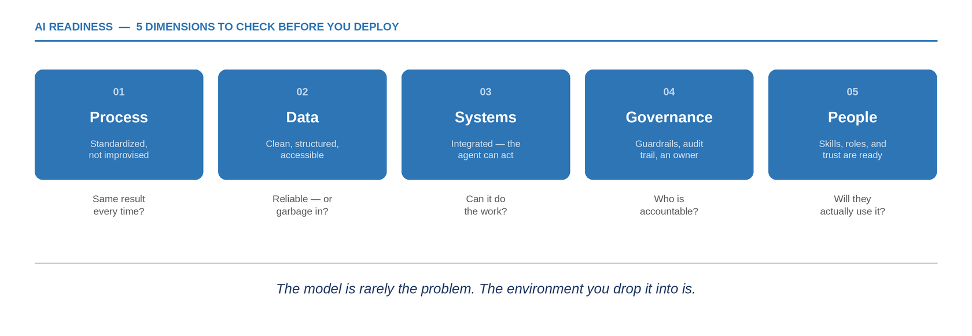
1. Process. Standardized, not improvised. An agent executes a process; it cannot invent a good one. If the steps live in one person’s head and change every month, the agent has nothing reliable to follow. This is process before platform applied to AI. Diagnostic: would you get the same result every time?
2. Data. Clean, structured, and accessible. Agents reason over your data, so data quality sets the ceiling on output quality — garbage in, confident garbage out. Diagnostic: is the data reliable, or would you be automating your errors at speed?
3. Systems. Integrated, so the agent can act. An agent that can read but not write, or that isn’t connected to the systems where work actually happens, can only advise. Real value comes from the ability to act through your tools. Diagnostic: can it do the work, or just talk about it?
4. Governance. Guardrails, an audit trail, and an owner. When an agent acts on its own, you need oversight built in: tolerance thresholds, approvals, logging, and a human who is accountable for what it does. Diagnostic: when the agent acts, who is responsible, and how do you verify it?5. People. Skills, roles, and trust are ready. Adoption is where AI projects quietly die. If your team doesn’t trust the agent or hasn’t been brought along, they will route around it and you’ll have paid for nothing. Diagnostic: will your people actually use it?
How to use the assessment
Most teams are strong on one or two dimensions and deploy anyway — then wonder why the pilot stalled. The point of scoring all five is to find your weakest link before the agent does, because that is where the deployment will break first. A brilliant model on a broken process, dirty data, or a team that doesn’t trust it will underperform a modest model in a ready operation every time.
Treat the lowest score as your starting project. If process is your gap, standardize before you automate. If data is the gap, clean and structure it first. Readiness work is unglamorous, but it is the work that decides whether the AI pays off.
AI readiness checklist
A quick checklist to gauge whether your operation is ready for an agent:
- You’ve chosen a bounded, high-volume, measurable first use case — not your hardest problem.
- The target process is documented and runs the same way every time — not improvised per person.
- The data the agent will use is clean, structured, and accessible from one source of truth.
- The agent can connect to and act within your systems — not just read or recommend.
- Guardrails, approval thresholds, and an audit trail are defined, with a named human owner.
- Your team understands what the agent will do, trusts it enough to use it, and knows how their role changes.
The payoff: deploy where you’re ready, fix where you’re not
Done in this order, AI stops being a gamble. You deploy agents where you’re ready and see real, compounding returns; and where you’re not ready, you have a clear, prioritized list of what to fix first. Either way you stop spending on tools that were never going to land, and you build the foundation that makes the next deployment easier than the last.
The companies that win with AI in the mid-market aren’t the ones that bought first. They’re the ones that got ready first.
Frequently asked questions
What does it mean to be AI-ready?
Being AI-ready means your operation can hand a task to an AI agent and trust the result, because the surrounding conditions — standardized process, clean data, connected systems, governance, and prepared people — are in place. It is about the environment around the agent, not the sophistication of the agent itself.
Why do so many AI projects fail?
Most fail on readiness, not on the model. Today’s models are highly capable, so the weak link is usually an improvised process, messy data, disconnected systems, missing governance, or low user trust. Fixing those is what turns a stalled pilot into a working deployment.
How do I assess AI readiness?
Score your operation across five dimensions — process, data, systems, governance, and people — each with a diagnostic question. Your lowest-scoring dimension is where deployment will struggle first and where you should focus before deploying.
Where should a mid-market company start with AI agents?
Start with a bounded, high-volume, measurable use case where you score well on readiness — not your hardest problem. Prove value in a ready environment, then expand, fixing readiness gaps as you go.
Not sure you’re ready?
SPX runs a structured AI readiness assessment for mid-market companies — scoring your process, data, systems, governance, and people, and mapping the fastest path to a deployment that actually pays off.
→ Book an AI readiness assessment with SPX.
Cedric Thomas, CEO · cthomas@spxltd.com · spxltd.com