Every vendor now leads with AI. Here’s how mid-market companies should actually choose — and where AI really belongs in the decision.
By Cedric Thomas, CEO · Strategy Planning Execution · cthomas@spxltd.com
Choosing an ERP has always been one of the highest-stakes decisions a mid-market company makes. In 2026, the vendors added a new layer of noise on top of it: every one of them now leads with AI. NetSuite points to Text Enhance and Bill Capture. Microsoft has Copilot woven through Dynamics 365 and a growing fleet of finance agents. SAP has Joule, with dozens of agents and thousands of skills. The demos are genuinely impressive.
This is exactly why so many selection processes go wrong. Teams start by comparing AI feature lists, get dazzled by whoever demoed best, and back into a platform decision that should have started somewhere else entirely.
This guide is the framework we use with mid-market clients: how to actually choose between NetSuite, Dynamics 365, and SAP in 2026, a fair profile of each, and where AI genuinely belongs in the decision — which, spoiler, is not at the front.
Start with fit, not the AI features
Here’s the uncomfortable truth about ERP AI in 2026: the capabilities are converging. All three platforms now embed a generative assistant, AI-assisted invoice and document capture, forecasting and anomaly detection, and — increasingly — autonomous agents that can run pieces of the close, procurement, or accounts payable. The names differ, but at the category level, what one ships this year the others ship within a release or two.
That makes AI a poor thing to choose on. Anchor your decision on the AI feature matrix and you’re optimizing for the fastest-moving, least-durable part of the platform — the part most likely to look completely different eighteen months after you sign.d. An assisted close automates pieces but still depends on people to drive it. An autonomous close inverts the ratio: the system runs the routine and surfaces only what needs a human. Most mid-market finance teams sit between manual and assisted today; the goal is not to leap straight to fully autonomous, but to move steadily up that spectrum.
Choose on what is durable. The AI will follow; fit with your business won’t.
So start where the differences are real and lasting: fit. Which platform fits your business, your existing technology, your appetite for implementation, and your team? Get that right and the AI will be there — all three are investing heavily. Get it wrong, and the best AI features in the world won’t save you.
How to choose: the five criteria that actually matter
We score every ERP decision on five criteria, in this order:
- Business fit. Your industry, size, and genuine complexity — multi-entity, multi-currency, manufacturing, regulatory exposure. This is the single biggest driver of the decision.
- Ecosystem fit. What you already run. An ERP that lives inside the tools your team uses every day carries a large adoption advantage before anyone turns on a single feature.
- Implementation reality. Time to go live, cost, and disruption. The most capable platform is worthless if the implementation breaks the business — and mid-market go-lives slip more often than anyone admits.
- Total cost of ownership. Not the license quote — the five-year number: licenses, implementation, integration, and the AI features, which increasingly sit behind separate editions and contracts.
- AI direction. Where the platform’s AI is heading, and whether it’s actually available in the edition you’d buy. This is the tiebreaker, not the anchor.
Notice AI is last. That’s deliberate — and it’s the discipline most selection processes are missing.
The three platforms, fairly
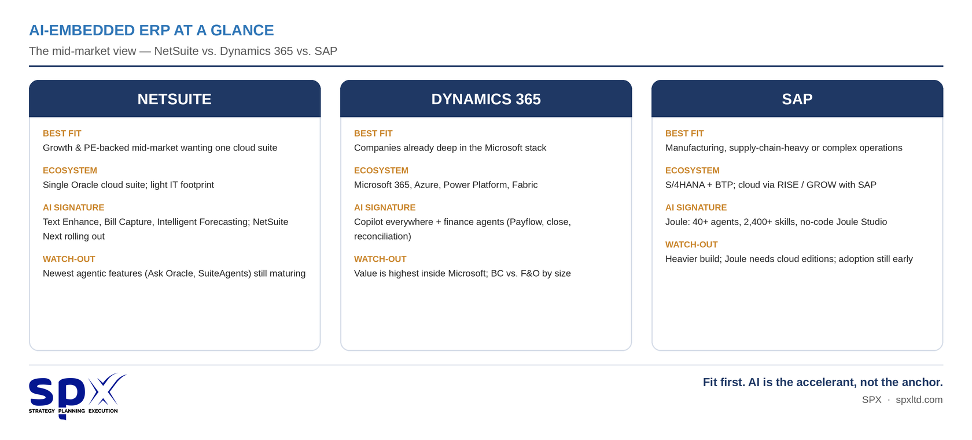
NetSuite. The cloud-native pioneer. Born in the cloud long before that was fashionable, NetSuite remains one of the strongest fits for growth-stage and PE-backed mid-market companies that want a single, broad suite without a heavy IT footprint. Its AI today includes Text Enhance (generative drafting inside record fields), Bill Capture (AI-driven vendor-invoice extraction and matching for AP), and intelligent forecasting and predicted fields. The bigger story is NetSuite Next — Oracle’s ground-up, AI-woven reimagining of the platform, with capabilities like Ask Oracle and SuiteAgents — rolling out in phases through 2026. Best fit: growth and PE-backed companies that want one cloud suite and light IT. Watch-out: the most exciting agentic pieces are still maturing, so buy on what’s generally available today, not the roadmap.
Dynamics 365. The Microsoft-ecosystem play. If your company already lives in Microsoft 365, Azure, and the Power Platform, Dynamics 365 has a structural edge: the data, the identity, and the AI all sit in one stack. Microsoft splits the product by size — Business Central for smaller mid-market, Finance & Operations for larger, more complex organizations (roughly $50M to $10B-plus in revenue). On AI, Copilot is embedded across the suite, and 2026 marked a clear shift from chatbot to agents: a Finance Agent, a Payflow Agent for payment automation, and autonomous agents for close and reconciliation, built on Copilot Studio and Azure OpenAI with a fast-growing partner ecosystem. Best fit: companies already committed to Microsoft. Watch-out: the value is highest inside that ecosystem — outside it, the math changes.
SAP. The enterprise heavyweight, reaching down-market. SAP is the deepest platform of the three, especially for manufacturing, supply chain, and genuinely complex operations. For the mid-market it offers S/4HANA through the cloud programs RISE and GROW with SAP, and Business One for smaller companies. Its AI, Joule, has grown into an agentic platform — more than 40 specialized agents and thousands of skills across finance, procurement, and supply chain, plus a no-code Joule Studio that finally puts agent-building within reach of a mid-market team. Best fit: manufacturing- and supply-chain-heavy or highly complex operations. Watch-outs: implementations run heavier and pricier; Joule requires the cloud editions (classic on-prem gets no native Joule); production adoption is still early across the industry; and if you’re on legacy SAP, the ECC support deadline at the end of 2027 is already forcing the timeline.
Where AI actually fits in the decision
Once you’ve narrowed on fit, AI becomes useful as a tiebreaker — if you evaluate it honestly. Two rules keep you out of trouble.
First, judge the AI on the workflows you actually run, not the demo. Every vendor will show you a dazzling generative moment. What you care about is your month-end close, your AP, your reporting, your forecasting. Ask each vendor to run those specific scenarios, with something that resembles your data.
Second, remember the AI only works on a foundation you may not have yet. An AI close agent needs a standardized close. A forecasting model needs clean, consistent data. AI scales whatever it finds — point it at a messy process and it just makes the mess faster. The platform’s AI maturity matters far less than your own readiness to use it.
And one practical trap: AI features increasingly sit behind specific editions, SKUs, and cloud contracts. Joule needs RISE or GROW; some NetSuite and Dynamics capabilities are licensed separately. Verify what’s included in the edition you’d actually buy — not the one in the keynote.
How to run the selection
Put it together into a short, disciplined process:
Write your requirements first — before you take a single demo. If you can’t put your must-haves on a couple of pages, you’re not ready to choose. Then score each platform on the five criteria, weighted for your business. Run the same two or three real scenarios — your close, your AP, your reporting — as scripted demos on every shortlisted vendor, using the same script and the same shape of data each time. Check references at your size and in your industry, not the vendor’s flagship logos. Model five-year total cost, AI SKUs included. Then decide on fit, and let AI break the tie.
Do that, and you’ll choose a platform you can live with for a decade — not one you picked because its AI demoed well on a Tuesday.
Frequently asked questions
Which ERP has the best AI in 2026?
There isn’t a clean winner, and that’s the point. NetSuite, Dynamics 365, and SAP have all invested heavily, and their capabilities are converging at the category level — generative assistants, document automation, forecasting, and autonomous agents. The better question isn’t which has the best AI, but which best fits your business, because that’s the difference that lasts.
Is NetSuite or Dynamics 365 better for the mid-market?
It depends on your ecosystem and complexity. NetSuite is often the cleaner fit for growth and PE-backed companies that want one cloud suite with light IT. Dynamics 365 tends to win when you’re already committed to Microsoft 365, Azure, and the Power Platform, since the data and AI live in the same stack.
Do I need to move to the cloud to get the AI?
Largely, yes. The newest AI — SAP’s Joule especially — is gated behind cloud editions, and NetSuite and Dynamics deliver their AI through their cloud platforms. If you’re on legacy on-prem, an AI strategy and a cloud-migration strategy are effectively the same conversation.
Should we switch ERPs just to get AI?
Rarely. Most of the AI value depends on a standardized process and clean data, which you can start fixing on your current system today. Switch ERPs for fit reasons — outgrowing the platform, a bad architecture, a major business change — and treat AI as a benefit of the move, not the reason for it.
Choosing — or re-evaluating — your ERP?
SPX runs vendor-neutral ERP selection for mid-market companies: we start from your requirements and fit, pressure-test each platform on your real workflows, and model the true five-year cost — AI included.
→ Book an ERP selection assessment with SPX.
Cedric Thomas, CEO · cthomas@spxltd.com · spxltd.com