

How mid-market finance teams can use AI to run the month-end close — and the four stages to get there.
By Cedric Thomas, CEO · Strategy Planning Execution · cthomas@spxltd.com
Ask any mid-market controller what the last week of the month feels like and you will hear a version of the same story: late nights, a wall of reconciliations, a scramble for variance explanations, and a final number that lands days after leadership wanted it. The monthly close is one of the most predictable, most repeated processes in the entire company — and in most mid-market finance teams, it is still done largely by hand.
That is exactly the kind of work AI is now good at. An autonomous close — an AI-driven month-end close that largely runs itself, with finance stepping in for judgment rather than data entry — has moved from conference-keynote fantasy to something mid-market companies can realistically build toward in 2026. The major ERPs now ship AI that can reconcile accounts, draft journal entries, flag anomalies, and even write a first pass of variance commentary. But “the software can do it” and “your close runs itself” are separated by a great deal of unglamorous work — and the teams that skip it end up automating a mess. This guide explains what an autonomous close actually is, why AI alone will not fix your month-end close, and a practical four-stage roadmap to get from where you are today to a close that mostly runs without you..
What is an autonomous close?
An autonomous close is a month-end process in which AI handles the mechanical majority of the work — reconciliations, recurring journal entries, intercompany matching, anomaly detection, and first-draft variance commentary — while the finance team focuses on judgment, exceptions, and analysis.
Autonomous does not mean unattended. It does not mean a finance team of zero, or a black box that posts entries no one reviews. Think of month-end maturity as a spectrum. A manual close is keyed and checked by humans end to end. An assisted close automates pieces but still depends on people to drive it. An autonomous close inverts the ratio: the system runs the routine and surfaces only what needs a human. Most mid-market finance teams sit between manual and assisted today; the goal is not to leap straight to fully autonomous, but to move steadily up that spectrum.
Why AI alone won’t fix your month-end close
Regular readers will recognize the theme: process before platform. It applies to the close more than almost anywhere else.
An AI agent will reconcile your accounts beautifully — if your chart of accounts is clean and consistent. It will draft your journals — if your close follows the same steps every month. Point it instead at a close where every entity does things its own way, where half the work lives in one person’s spreadsheets, and where the calendar is reinvented each month, and it will simply automate the chaos faster. The technology amplifies whatever process you give it.
You can’t automate a close you haven’t standardized.
So the order of operations matters. You standardize the close, then you automate the mechanical parts, then you layer in intelligence, and only then do you arrive at something that genuinely runs itself. Skip the standardization and you are not building an autonomous close — you are building an expensive way to make this month’s mess permanent.
The autonomous close roadmap: 4 stages
We take finance teams up the same four stages of month-end close automation, in order. Each stage has a single gate question; you do not advance until you can answer it honestly.
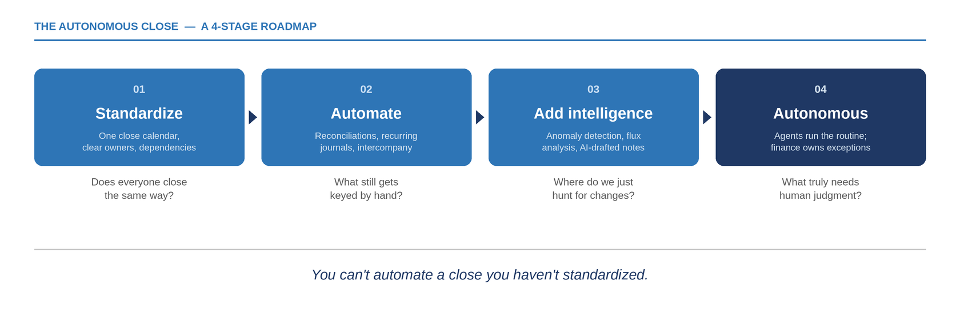
Stage 1 — Standardize. Make the close the same every month, in every entity. One close calendar with named owners and explicit dependencies; a consistent chart of accounts; a defined set of recurring entries. This is the foundation everything else sits on. Gate question: does everyone close the same way?
Stage 2 — Automate the mechanical. Hand the repetitive, rules-based work to the system. Account reconciliations, recurring and accrual journals, intercompany matching, and roll-forwards — the high-volume, low-judgment tasks that eat the first three days of every close. Gate question: what still gets keyed by hand?
Stage 3 — Add intelligence. Let AI find what your team currently hunts for. Anomaly detection on transactions, automated flux and variance analysis, and AI-drafted commentary that explains what moved and why — so analysts review and refine rather than assemble from scratch. Gate question: where do we just hunt for changes?
Stage 4 — Autonomous close. Agents run the routine; finance owns the exceptions. The close executes on schedule, the system escalates only what falls outside tolerance, and your team’s month-end becomes review and analysis instead of production. Gate question: what truly needs human judgment?
How to start automating your month-end close
If you are early on this path, resist the urge to chase the most impressive capability first. The fastest return almost always comes from the least glamorous stage: automating reconciliations and recurring journals. They are high-volume, rules-based, and consume a disproportionate share of the close — which means automating them frees the most time for the least risk. Anomaly detection and AI commentary are powerful, but they pay off most once the mechanical foundation is solid and the data feeding them is clean.
As a rule of thumb: automate the work that is repetitive and rules-based before the work that requires interpretation. Let the system earn trust on the boring tasks before you hand it the nuanced ones.
Autonomous close readiness checklist
Before you expect a close to run itself, a few things need to be true. Use this readiness checklist to gauge how close you are:
- A single, standardized close calendar with named owners — not a different rhythm per entity or per person.
- A clean, consistent chart of accounts across the business, so the AI is matching like with like.
- The close lives in the system, not in a constellation of personal spreadsheets only one person understands.
- Controls and a clear audit trail for anything the AI posts — review thresholds, approvals, and logging built in from the start.
- A defined list of what counts as an exception, so the system knows what to handle and what to escalate.
The payoff: a faster close and a higher-value finance team
A faster close is the obvious win — days back every month, leadership getting numbers while they are still useful. But the deeper payoff is what your finance team does with the time. When the mechanical work runs itself, your most capable people stop assembling the numbers and start interpreting them: explaining the business, pressure-testing the forecast, and partnering with operations instead of chasing reconciliations at 9 p.m. That shift is the real prize, and it is only available to teams that do the work in the right order. Standardize the close. Automate the mechanical. Add the intelligence. Then let it run — with your people watching the exceptions, not keying the entries
Frequently asked questions
What is an autonomous close?
An autonomous close is a month-end close in which AI runs the mechanical majority of the work — reconciliations, recurring journals, intercompany matching, anomaly detection, and draft commentary — while finance handles judgment and exceptions. It is the most mature stage on a spectrum that runs from manual to assisted to autonomous.
Can AI close the books on its own?
Not entirely, and that is not the goal. AI can automate the repetitive, rules-based parts of the close and flag what needs attention, but humans still own review, approvals, and judgment calls. “Autonomous” means the routine runs itself and people focus on the exceptions — not that the close is unattended.
How long does it take to reach an autonomous close?
It depends far more on process maturity than on technology. Teams with a standardized close and a clean chart of accounts can automate the mechanical stages relatively quickly; teams that first have to standardize should expect that groundwork to take longer. The roadmap is meant to be climbed one stage at a time, not in a single project.
Do I need a new ERP to automate month-end close?
Often no. Many mid-market ERPs already ship AI-driven close and reconciliation capabilities, and the bigger constraint is usually whether your process is standardized enough to use them. Fix the process first; then decide whether your current platform can take you where you want to go.
Cedric Thomas, CEO · cthomas@spxltd.com · spxltd.com
Ready to shorten your close?
SPX helps mid-market finance teams standardize the close, automate the mechanical work, and put AI where it earns its place — in the right order. We start with a short assessment of your current close and map your fastest path up the four stages.

Leave a Reply