
No project dies from one big decision. It dies from fifty small “while we’re at its.” Here’s how to hold the line without becoming the department of no.
By Cedric Thomas, CEO · Strategy Planning Execution · cthomas@spxltd.com
Ask anyone why their last big project ran six months late, and you’ll rarely hear about a single catastrophic decision. You’ll hear about a hundred small ones. A feature added here. A “quick” extra report there. A stakeholder who really needed just one more thing. None of them looked like much on its own. Together, they buried the timeline.
That’s scope creep, and it’s the quiet killer of mid-market projects — implementations, integrations, transformations, all of them. The good news is that scope creep is preventable. Not by freezing scope and refusing all change, which is both impossible and unwise, but by having the discipline to decide about every change on purpose. This is a guide to that discipline.
Scope creep vs. scope change
First, a distinction that matters. Scope change is healthy and inevitable — you learn things during a project, the business shifts, a genuinely better idea surfaces. Pretending the plan you drew on day one is sacred is its own kind of failure. The goal isn’t zero change.
Scope creep is different. Scope creep is change that happens without a decision — additions that slip in through the side door, unowned, unbudgeted, uncounted, until one day the project is twice the size it was scoped to be and nobody can say exactly when that happened. The problem was never that scope changed. It’s that it changed without anyone deciding to let it.
“We’ll just add it” is how a six-month project becomes an eighteen-month one.
The phrase that kills projects
Listen for four words on any project in trouble: “we’ll just add it.” It sounds accommodating, cooperative, low-cost. It is none of those things. It’s a decision to expand the project — made casually, by whoever happened to be in the room, usually without anyone pricing the time, the testing, the ripple effects, or what it pushes back.
Every “just add it” has a bill attached, and the bill is almost never just the feature. It’s the retesting, the extra integration, the documentation, the training, and the schedule everything else now slips behind. The feature is the tip; the cost is the iceberg underneath — and “just” is the word that hides it.
The change-request triage
The discipline isn’t saying no to everything. It’s running every request through the same quick triage, out loud, before it becomes work. Ask one question of any change — is it needed to hit the original goal? — and sort the answer into one of three buckets.
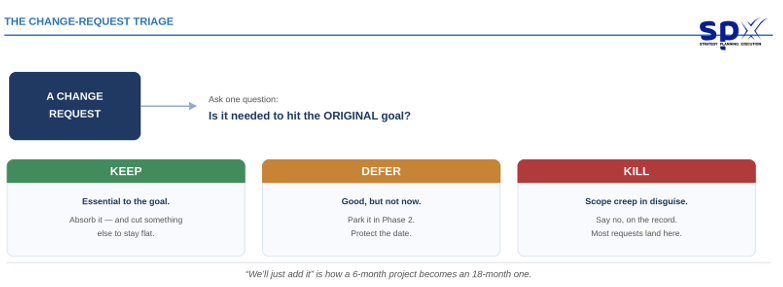
Keep. It’s genuinely essential to the goal you committed to. Fine — but “keep” is not free. If you add it, something else comes out, or the date moves, or the budget grows, and you say which, out loud, now. A change that’s absorbed without a trade-off isn’t absorbed; it’s hidden.
Defer. It’s a good idea, but it isn’t needed to hit this goal. Don’t argue about its merits — park it in a Phase 2 list. “Not now” protects the date without killing the idea, and a visible backlog is what lets you say it honestly.
Kill. It’s scope creep wearing the costume of a good idea. Say no — clearly, and on the record, so it doesn’t come back in through a different door next week. If you’re honest, most requests belong here, and the project is better for it.
How to hold the line without being “the department of no”
Scope discipline gets a bad reputation because it’s done badly — as a reflexive no that makes the project team look rigid and unhelpful. Done well, it’s the opposite: it’s how you protect the thing everyone actually agreed to. A few practices make the difference.
Write the goal down, and point at it. Scope discipline is impossible without a clear, agreed definition of what this project is for. Every triage question — “is this needed to hit the goal?” — depends on a goal specific enough to answer it. If people disagree about whether something is in scope, you usually have a goal problem, not a scope problem.
Make the trade-off visible. The magic isn’t “no.” It’s “yes, and here’s what moves.” When a sponsor sees that their new feature costs three weeks or bumps another feature they care about, the conversation changes from “why won’t you do this?” to “is this worth that?” — which is the real question all along.
Give ‘no’ a home. A Phase 2 backlog turns rejection into deferral. “That’s a great idea for the next release” is a yes to the idea and a no to the disruption, at the same time. People accept “later” far more easily than “never.”
Govern it, don’t improvise it. Changes get decided in one place, by someone with the authority to make the trade-off — not in hallway conversations and side emails where no one is counting. A lightweight change log that everyone can see is enough; the point is that changes are decided, not absorbed.
Where it goes wrong
Two failure modes, opposite in shape. The first is the open door: every request gets a yes, nothing gets priced, and the project quietly doubles until it collapses under its own weight. The second is the slammed door: a reflexive no to everything, including the changes that genuinely matter, until the project ships something technically on-scope and practically useless because the world moved and it didn’t. Scope discipline is the narrow path between them — not no, and not yes, but decide.
What good looks like
A project with real scope discipline is calm about change. Requests come in — they always do — and instead of anxiety or argument, they get triaged: kept with a visible trade-off, deferred to a backlog everyone can see, or killed on the record. The timeline holds because every addition had to earn its place by displacing something else. And the team doesn’t look obstructive, because they’re not saying no — they’re saying “here’s the trade,” which is the most helpful thing a project can say.
Frequently asked questions
What is the difference between scope change and scope creep?
Scope change is a deliberate, decided adjustment to the plan — healthy and often necessary. Scope creep is change that happens without a decision: unowned, unbudgeted additions that accumulate until the project is far bigger than it was scoped to be. The issue isn’t that scope changed; it’s that it changed without anyone choosing to let it.
How do you stop scope creep without blocking good ideas?
Triage every request against one question — is it needed to hit the original goal? — and sort it into keep (essential, with a visible trade-off), defer (good, but parked in a Phase 2 backlog), or kill (scope creep, declined on the record). You’re not saying no to ideas; you’re protecting the goal everyone agreed to.
Who should approve scope changes?
One accountable owner or a small change-control body with the authority to make the trade-off — not hallway conversations and side emails. Changes should be decided in one visible place, with the cost and what-it-displaces named, so nothing gets absorbed by default.
Isn’t refusing changes just being inflexible?
Only if you refuse everything, which is its own failure. Good scope discipline isn’t “no” — it’s “yes, and here’s what moves.” Making the trade-off visible turns the conversation from whether you’ll do something into whether it’s worth what it costs, which is the decision that should have been made anyway.
Watching a project quietly balloon?
SPX brings delivery and scope discipline to mid-market projects — a clear goal, a real change-control process, and the triage that keeps the timeline honest without turning the team into the department of no.
→ Book a delivery assessment with SPX.
Cedric Thomas, CEO · cthomas@spxltd.com · spxltd.com