
Selling a division is the easy part. Untangling it is where the value leaks.
By Cedric Thomas, CEO · Strategy Planning Execution · cthomas@spxltd.com
Divestitures get a fraction of the attention acquisitions do, but they’re often harder to execute. Carving a business out of a larger one means separating systems, data, people, contracts, and costs that were never designed to come apart — and doing it without breaking either the business you’re selling or the one you’re keeping.
This is the playbook for a clean separation: what makes it hard, the phases that structure it, and the traps — TSAs and stranded costs chief among them — that quietly eat deal value.
Why a carve-out is harder than the deal
The business you’re selling is entangled with everything around it: a shared ERP and CRM, shared services like IT, HR, and finance, shared contracts, shared facilities, and people who work across both sides. Nobody built it to be separable, because for years there was no reason to.
So the separation is a full program in its own right, and it’s almost always underestimated — because the entanglement is invisible until you start pulling on threads and discover how much is connected to what you’re removing.
A clean carve-out is designed, not discovered.
The separation timeline
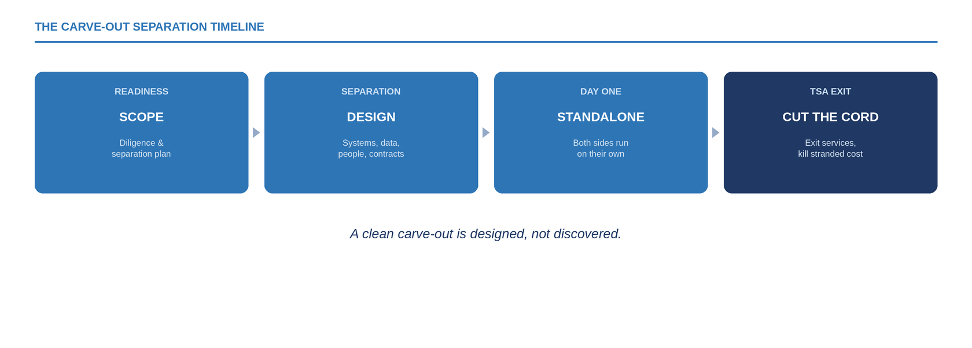
A carve-out runs through four phases, and the scope work up front drives the entire deal timeline:
Readiness. Diligence and separation scope — a clear-eyed inventory of what actually has to come apart, and how entangled it really is.
Separation design. The plan for each dimension: systems, data, people, and contracts. This is where the real engineering happens.
Day One. Both sides operate standalone — or on a transition-services bridge — without breaking service to customers or employees.
TSA exit. Cut the cord: exit the transition services on schedule and take out the stranded costs left behind.
The two-sided rule
A divestiture has two patients on the table: the business being sold (often called DivestCo) and the business you’re keeping (RemainCo). A clean separation protects both. It’s easy to pour all the energy into standing up DivestCo and forget that RemainCo is left with stranded costs, orphaned processes, and gaps where the divested unit used to sit. Break RemainCo to free DivestCo and you’ve simply moved the damage, not avoided it.
TSAs: the bridge you’ll regret not scoping
A Transition Service Agreement lets the divested business keep buying services — IT, payroll, finance, and the rest — from the seller for a defined period after close. TSAs are usually necessary; almost nothing separates cleanly on Day One. But a loosely scoped TSA is a trap.
Scope it too thin and you break the business the day a service you forgot disappears. Leave it open-ended and the separation never actually happens — the bridge becomes permanent. Misprice it and one side quietly subsidizes the other. Decide up front exactly what’s included, what the exit plan and hard exit date are, and how it’s priced. Every TSA is a countdown timer; set it deliberately.
Stranded costs: where the value leaks
When a business leaves, its share of the overhead doesn’t automatically leave with it. RemainCo is left holding stranded costs — the datacenter, the software seats, the support staff, the facilities — all sized for a company that’s now smaller. Left unaddressed, stranded costs quietly consume the proceeds of the deal.
The fix is to plan the cost take-out as part of the separation, not as a cleanup afterward. Know, before Day One, which costs become stranded and exactly how and when you’ll remove them.
Systems and data separation
The hardest technical work in a carve-out is cleanly splitting a shared ERP or CRM and the data inside it — deciding who gets which records, how shared history is handled, and how to keep security and compliance intact throughout. For each system you’ll choose to clone it, carve it, or rebuild standalone, and each path has very different cost and timeline. Data separation is almost always where carve-out timelines slip, so start it early and treat it as the critical path it usually is.
Where it goes wrong
The recurring failures: underestimating the entanglement and the timeline; scoping TSAs loosely; ignoring stranded costs until they show up in next year’s budget; focusing on DivestCo and forgetting RemainCo; and leaving data separation to the end, where it derails Day One. All of them trace back to the same root: treating the separation as an afterthought to the deal rather than a designed program.
Give the separation a runway
The single most valuable thing a seller can do is start early. The separation scope should shape the deal timeline, not scramble to catch up to it — because the long poles, especially systems and data separation, take months, not weeks. Sellers who begin separation planning while the sale process is still running reach Day One with a real plan, a tightly scoped TSA, and a stranded-cost take-out already mapped.
Sellers who wait until signing spend the first months of the TSA discovering how tangled things are — on the clock, and paying the buyer for the privilege. Runway is the cheapest advantage in a carve-out, and it costs nothing but attention paid sooner rather than later.
Frequently asked questions
What makes a divestiture harder than an acquisition?
Separation. You’re untangling systems, data, people, and costs that were never designed to come apart — and doing it without breaking either side. The entanglement is invisible until you start, which is why carve-outs are so routinely underestimated.
What is a TSA, and why does it matter so much?
A Transition Service Agreement lets the divested business keep buying services from the seller for a set period after close. It matters because loose scoping is a trap — too thin breaks the business, too long prevents real separation, and mispricing lets one side subsidize the other. Scope, exit date, and price should all be set up front.
What are stranded costs?
The overhead left behind when a business is divested — datacenters, software licenses, support staff, facilities sized for a larger company. Unaddressed, they eat the deal proceeds, so the cost take-out should be planned as part of the separation.
When should divestiture planning start? As early as possible. The separation scope drives the whole deal timeline, and data and systems separation — the usual bottleneck — needs a long runway. The earlier you understand the entanglement, the cleaner the exit.
Carving out a business — or preparing to?
SPX runs divestiture and carve-out separation for mid-market companies and their PE sponsors: separation design, TSA scoping, systems and data split, and stranded-cost take-out — protecting both sides of the deal. → Book a separation readiness assessment with SPX.
Cedric Thomas, CEO · cthomas@spxltd.com · spxltd.com