
Most transformations are events — a go-live, a launch, a big push. The ones that last are habits. Here’s how to turn the event into something that holds.
By Cedric Thomas, CEO · Strategy Planning Execution · cthomas@spxltd.com
There’s a particular kind of disappointment that shows up about a year after a big transformation. The system went live, the launch was a success, everyone celebrated — and then, slowly, the old way crept back. The workarounds returned. The shadow spreadsheets reappeared. The shiny new process quietly reverted to something that looks a lot like what you had before. The change didn’t fail at go-live. It failed at month nine, when nobody was watching anymore.
This is the problem with treating transformation as an event. An event has an end. And the moment the event ends — the consultants leave, the project team disbands, attention moves to the next priority — the pull of the old way reasserts itself. Change that isn’t sustained doesn’t hold its ground; it slides back. This is a guide to the operating rhythms that keep it from sliding.
Why change slides back
Understand the default and you can design against it. Organizations, like people, have a homeostasis — a strong, invisible pull toward the way things were. The old process is grooved into muscle memory, informal networks, and a hundred small habits. A transformation fights that groove for a few intense months, and while everyone is paying attention, the new way wins. But attention is finite. When it moves on, the groove is still there, and the new way — not yet a habit — is the thing that gives.
A transformation is an event. The change that lasts is a habit.
So the goal of sustaining change isn’t more willpower or another big push. It’s to make the new way the path of least resistance — the default that happens without anyone forcing it. That’s what an operating rhythm does: it bakes the change into how the organization runs, so staying changed takes no more effort than reverting used to.
The five rhythms that sustain change
Five operating rhythms turn a transformation from an event into a habit. None of them are dramatic — that’s the point. They’re the quiet machinery that keeps the change running after the spotlight moves on.
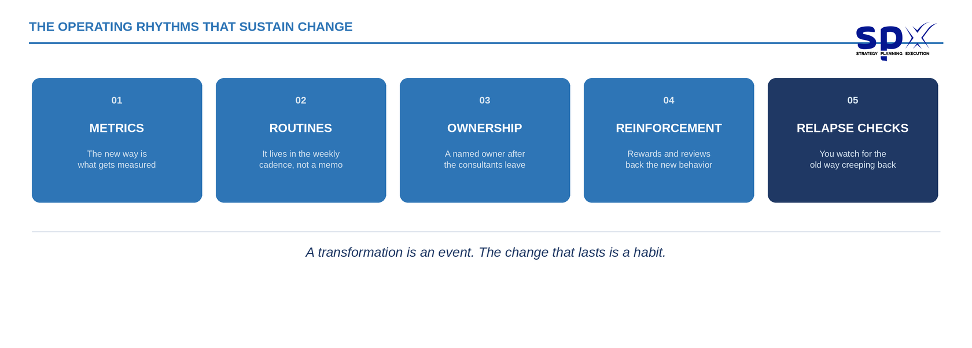
1. Metrics. What gets measured is what sticks. If the new way of working isn’t reflected in the numbers leaders actually look at, it will quietly lose to whatever is. Build the change into your regular reporting — so adherence and its results are visible every week, not just in the project’s final readout.
2. Routines. Change has to live in the cadence of the business, not in a memo. Weekly reviews, standing meetings, the standard agenda, the checklist everyone uses — that’s where behavior actually lives. If the new way isn’t embedded in the routines people already run, it depends on memory, and memory fades.
3. Ownership. Someone has to own the change after the project team is gone. Not a committee — a named person whose job includes keeping the new way alive, with the authority to do it. Transformations that revert almost always had no owner the day after the consultants left.
4. Reinforcement. People do what’s rewarded and stop doing what isn’t. If your incentives, reviews, and recognition still quietly reward the old behavior, the old behavior wins — no matter what the new process says. Align what you celebrate and measure people on with the way you actually want them to work.
5. Relapse checks. Assume the old way will try to creep back, and watch for it on purpose. A light, periodic check — are we still doing this the new way, or has drift set in? — catches reversion while it’s small. Caught early, relapse is a nudge; caught late, it’s a second transformation.
The handoff that decides everything
If there’s a single moment where sustained change is won or lost, it’s the handoff — when the project ends and ongoing operations take over. Most transformations treat this as an afterthought: the project closes, the team celebrates, everyone moves on, and no one is left explicitly holding the change. That gap is where reversion begins.
Plan the handoff as deliberately as you planned the launch. Before the project team disbands, know exactly who owns the change, which metrics they’ll watch, which routines carry it, and when the first relapse check happens. The transformation isn’t done when it goes live. It’s done when it can run without the people who built it — and that’s a thing you design, not a thing you hope for.
Where it goes wrong
The signature failure is declaring victory at go-live. The launch works, the metrics look good in month one, the team moves on — and because nobody built the rhythms, the gains erode so gradually that no single week looks like failure. By the time someone notices the old way is back, the project is a distant memory and re-doing it feels absurd. The other failure is subtler: building the rhythms but letting them decay — the metric that stops being reviewed, the owner who gets reassigned, the relapse check that quietly drops off the calendar. Sustaining change is itself a thing that needs sustaining.
What good looks like
Here’s the test, and it’s a one-year test, not a go-live test. Twelve months out, the new way is just “how we work” — nobody calls it “the new system” anymore. No one quite remembers the old workarounds. It survived the consultants leaving because a real owner kept it alive. The metrics that jumped at go-live held instead of eroding. And the team has kept improving it on their own, because it’s theirs now, not something that was done to them. That’s a change that stuck — and it’s the product of rhythms, not willpower.
Frequently asked questions
Why do transformations revert after go-live?
Because organizations have a strong default pull toward the old way, and a transformation only overcomes it while everyone is paying attention. When the project ends and attention moves on, the new way — not yet a habit — is what gives. Without operating rhythms to hold it, the gains erode gradually until the old way quietly returns.
What makes organizational change stick?
Operating rhythms that make the new way the default: metrics that measure it, routines that embed it, a named owner who sustains it, reinforcement that rewards it, and relapse checks that catch drift early. Change sticks when staying changed takes no more effort than reverting used to — not through willpower or another push.
When is a transformation actually finished?
When it can run without the people who built it. Go-live is a milestone, not the finish line. The transformation is done when ownership, metrics, routines, and reinforcement are in place and the change holds on its own — which is something you design into the handoff, not something you hope happens.
Who should own a change after the project ends?
A single named person whose role includes keeping the new way alive, with the authority to act — not a committee and not “everyone.” Transformations that revert almost always had no clear owner the day after the project team left. The handoff to that owner should be planned as carefully as the launch.
Worried your last transformation is already sliding back?
SPX helps mid-market companies make change stick — building the metrics, routines, ownership, and reinforcement that sustain a transformation long after go-live, so the gains you paid for don’t quietly erode.
→ Book a delivery assessment with SPX.
Cedric Thomas, CEO · cthomas@spxltd.com · spxltd.com