New system, same five failure modes. Almost none of them are the software.
By Cedric Thomas, CEO · Strategy Planning Execution · cthomas@spxltd.com
Whether it’s an ERP, a CRM, or whatever platform comes next, system implementations fail at a remarkable rate — and they fail for the same reasons, over and over. Here’s the uncomfortable part: almost none of those reasons are technical. The software works. The implementation doesn’t.
This is the anatomy of why implementations fail, how it differs between ERP and CRM, and the delivery discipline that prevents it.
It’s never really the software
Modern ERP and CRM platforms are mature, capable, and proven across thousands of companies. So when an implementation goes sideways, the cause is almost never the product — it’s how the product was implemented. Five failure modes account for the vast majority of it, and you’ll notice what’s missing from the list.
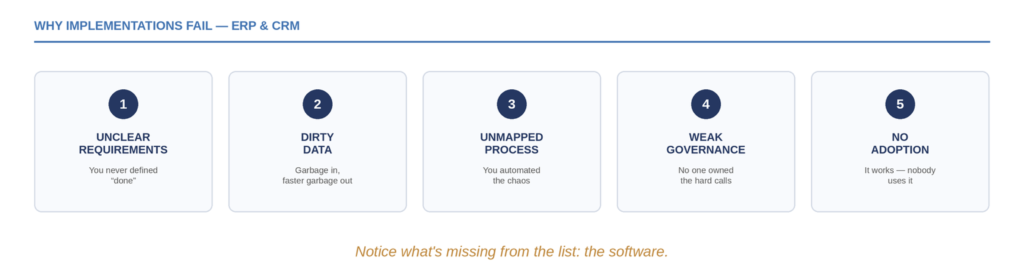
The five failure modes
1. Unclear requirements. You never actually defined what “done” looks like, so scope creeps, the project chases a moving target, and every configuration decision reopens a debate that should have been settled up front.
2. Dirty data. You migrate the mess. Garbage in, faster garbage out — and it’s especially fatal for CRM, where a system full of stale, duplicated, or wrong records gets abandoned by the people it was supposed to help.
3. Unmapped process. You configure the system to your broken process instead of fixing the process first. The platform faithfully automates the chaos, and now the chaos is enshrined in software that’s expensive to change.
4. Weak governance. No one owns the hard calls. Decisions stall, the steering committee only ever hears “green,” and the trade-offs that should be made deliberately get made by default instead.
5. No adoption. The system works and nobody uses it. The team keeps its spreadsheets and workarounds, the data decays, and the business case quietly evaporates — a technically successful project that changed nothing.
ERP vs. CRM: same failures, different emphasis
ERP: the risk is operational. When an ERP implementation goes wrong, the close breaks, orders stall, and you feel it in the running of the business. Data integrity and process discipline dominate the risk — you cannot afford to run the company on a system you don’t trust.
CRM: the risk is adoption. A CRM’s entire value is whether the sales team actually uses it. The most feature-complete CRM in the world is worthless if reps find it slower than their own notes. If it doesn’t make their day easier, they route around it, and a CRM nobody updates is worse than the spreadsheet it replaced. CRM implementations live or die on change management and simplicity, not on the feature list.
The delivery discipline that prevents it
Every failure mode has a discipline that answers it, and none of them are technical:
Requirements first. Define “done” before you touch the software. If you can’t write your must-haves on a couple of pages, you’re not ready to configure anything.
Fix the data before you migrate. Clean, deduplicate, and decide what not to bring. Migrating bad data just relocates the problem.
Optimize the process before you configure. Process comes before platform. Configure to a process you’ve actually re-engineered, not the one you happen to have.
Govern for the truth. Stand up a steering committee that hears the real status and makes the hard calls — and rewards the person who flags a risk early.
Treat adoption as a workstream. Not a training session at the end — a stream that runs from Day One, with the people who’ll use the system involved in designing it.
The meta-failure: treating it as an IT project
Underneath all five failure modes is one root cause: treating an implementation as an IT project. It isn’t. It’s a business change project that happens to involve software. The moment it’s owned by IT alone, the parts that actually determine success — requirements, process, governance, and adoption — go unowned, because they were never IT’s to own. IT is an essential partner in an implementation. It should never be the sole owner of one.
A note on rescuing a troubled implementation
If you’re reading this mid-project because something already feels off, the same five failure modes are your diagnostic. Stop and ask which ones are live: Are the requirements actually agreed, or still quietly moving? Is the data clean enough to trust? Did anyone re-engineer the process, or just replicate the old one in a new tool? Is there a governance body making real decisions, or a status meeting admiring green dashboards? And is anyone genuinely accountable for adoption?
A stalling implementation almost always traces to two or three of these — and the fix is rarely more software or a harder push to hit the go-live date. It’s usually to pause, name the real gap honestly, and close it before you cut over. A short, deliberate reset beats a fast, broken launch every time, because a failed go-live costs far more than a delayed one — in money, and in the credibility you’ll need for the next system.
Frequently asked questions
Why do ERP and CRM implementations fail so often?
Almost always for non-technical reasons: unclear requirements, dirty data, unmapped processes, weak governance, and poor adoption. The platforms are mature; the failures are in how they’re implemented, not what’s implemented.
What’s the number one reason CRM implementations fail?
Adoption. A CRM only creates value if the sales team uses it. If it’s slow, over-complicated, or full of bad data, reps route around it — and a CRM nobody updates is worse than no CRM at all.
Should we fix our processes before or after implementation?
Before. Configuring a system to a broken process bakes the dysfunction into expensive software. Map, measure, and re-engineer the process first, then implement.
Is a system implementation an IT project?
No — it’s a business change project that involves software. IT is a critical partner, but when IT owns it alone, the requirements, process, and adoption work that decides success goes unmanagedcutover be the thing that breaks your clean close.
Planning — or rescuing — an ERP or CRM implementation?
SPX leads ERP and CRM implementations for mid-market companies: requirements, data, process, governance, and adoption — so the system you buy is the system your team actually uses. → Book an implementation readiness assessment with SPX.
Cedric Thomas, CEO · cthomas@spxltd.com · spxltd.com