The diligence is done and the deal is closed. Now comes the part that actually determines whether it works.
By Cedric Thomas, CEO · Strategy Planning Execution · cthomas@spxltd.com
Most of the attention — and most of the advisory fees — in M&A go to getting the deal done. But the deal thesis, the synergies and growth and cost-out that justified the price, isn’t realized at signing. It’s realized, or quietly lost, in integration.
Integration is where mid-market acquirers most often stumble, because they treat it as an afterthought to the transaction — something the team will “figure out” once the ink dries. This is the playbook for capturing the value you paid for, without breaking the business you just bought.
Why deals fail in integration, not diligence
Diligence tells you what you’re buying. Integration determines what you actually get. The financial model assumed synergies; integration has to deliver them through real systems, real people, and real customers — none of which read the model.
And most value erosion happens after close, not before it: leadership gets distracted from the base business, cultures clash, key people leave in the uncertainty, customers sense the wobble and start shopping, and systems turn into a tangle nobody planned. The deal didn’t fail because the thesis was wrong. It failed because the thesis was never operationalized..
The deal is won or lost in integration — not in diligence.
The integration timeline
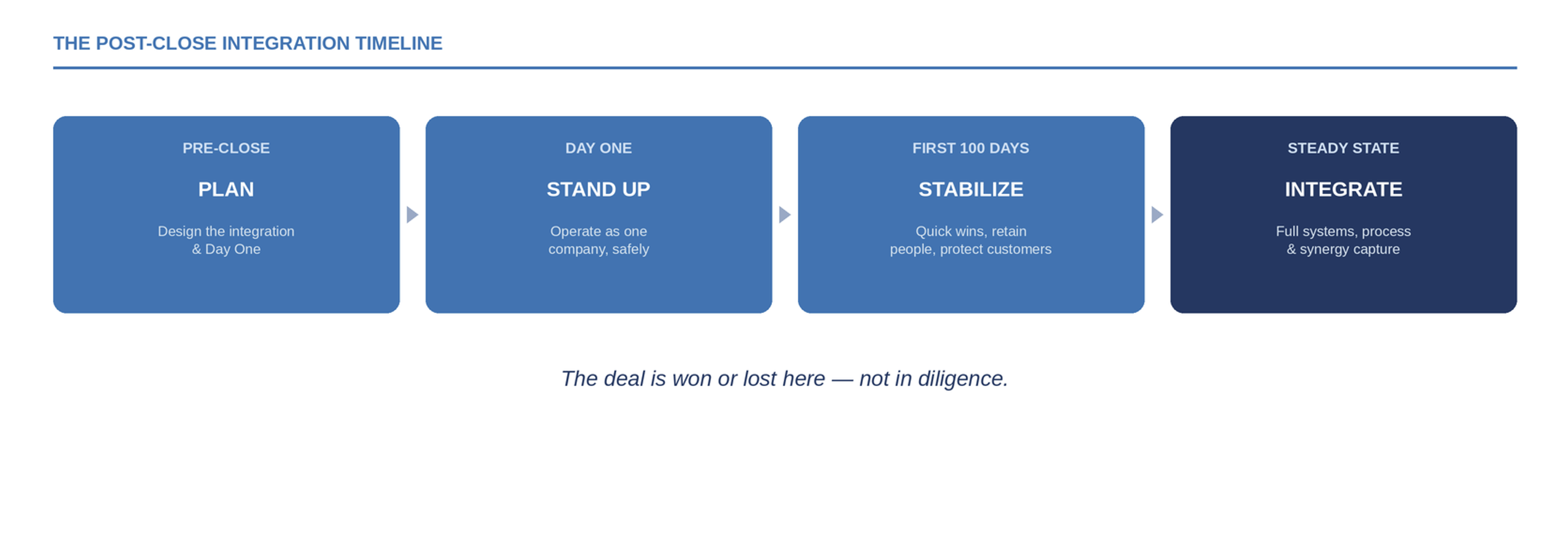
We run integration across four phases, and the first one starts before you own the company:
Pre-close. Design the integration and the Day One plan while the deal is still closing. This is the single biggest lever — and the one most often skipped, because everyone is busy closing.
Day One. Operate as one company, safely. Nothing critical breaks, everyone gets paid, and customers see continuity rather than chaos. Day One is not a celebration; it’s a stress test of your planning.
First 100 days. Stabilize, capture the obvious quick wins, retain the key people, and protect the revenue base. The trajectory of the whole deal is usually set here.
Steady state. Full systems and process integration, and the deliberate capture of the synergies the deal was built on — in waves, not all at once.
Know what you’re integrating for
Not every deal integrates the same way, and matching the approach to the thesis is what separates value creation from value destruction. Are you buying scale — where the synergy is in eliminating duplication, so you integrate deeply? Capability — a team or product you must protect, so you integrate lightly and resist the urge to absorb it? Or a platform — where you standardize the acquired business onto your systems and ways of working?
Get this backwards and you do real damage: over-integrate a capability acquisition and you smother the very thing you paid a premium for; under-integrate a scale deal and the synergies you underwrote never show up. Decide the integration thesis before Day One, not during it.
The workstreams that matter
Finance and systems. One chart of accounts, one close, consolidated reporting — and an early, deliberate decision on whether to integrate, migrate, or let the two ERPs coexist for a while. You cannot run a combined company on two sets of books indefinitely.
People and culture. Retain the people the deal depended on, give the organization clarity fast, and communicate honestly. Culture is the synergy nobody puts in the model and the one that most often sinks the deal.
Customers and revenue. Protect the revenue base first. The fastest way to destroy deal value is to let integration distract the team from the customers who generate the cash flow you just paid a multiple for.
Process. Harmonize the core processes — and resist the lazy default of simply picking one company’s way. Merging two companies’ processes isn’t choosing the better one; it’s designing the right third one.
Capturing synergies without breaking operations
Sequence is everything: stabilize before you optimize. Protect the core — payroll, customers, cash — on Day One, then capture synergies in deliberate waves. Where you can, run the old and new in parallel before you cut over. The classic failure is chasing synergy targets so aggressively that you break the operation that produces the value in the first place.
And give integration an owner. An Integration Management Office — even a lightweight one — with a clear cadence (30/60/90), real decision rights, and a live synergy tracker is the difference between integration as a managed program and integration as everyone’s part-time job and nobody’s priority.
Where it goes wrong
The common failures are all avoidable: no real Day One plan; leadership pulled off the base business; synergy targets chased recklessly; culture treated as soft and ignored; systems “figured out later” until later becomes a crisis; and key people left to drift out the door in the uncertainty. Each one is a planning failure, not bad luck.
What good looks like
A well-run integration is quiet. Day One passes and customers never notice anything changed — orders ship, invoices go out, the phones get answered by people who know the answers. The key players you were worried about are still there at ninety days, because someone made retaining them an explicit job rather than a hope. The synergy tracker shows steady, banked progress instead of a heroic number nobody believes. And the base business — the revenue and margin you actually paid a multiple for — held or grew while all of it happened.
If your integration feels dramatic, something is usually wrong. Calm, sequenced, and slightly boring is what a value-creating integration looks like from the outside — and it is almost always the product of planning that started before the deal closed, not heroics after it.
Frequently asked questions
When should post-close integration planning start?
Before close. The Day One plan and the integration thesis should be designed while the deal is still closing — pre-close planning is the single biggest predictor of a clean integration.
What’s the biggest cause of failed M&A integration?
Neglecting people, culture, and the base business while chasing synergies — usually because no one owns the integration full-time. The financials get the attention; the operational and human work that actually delivers the thesis goes unmanaged.
How long does integration take?
From Day One to true steady state is typically twelve to twenty-four months, but the first 100 days set the trajectory. Stabilize fast, then capture synergies in waves.
Should we integrate the two companies’ systems right away?
Stabilize first. Decide integrate, migrate, or coexist based on the deal thesis — and never let a systems cutover be the thing that breaks your clean close.
Just closed a deal — or about to?
SPX runs post-close integration for mid-market acquirers and their PE sponsors: a real Day One plan, an Integration Management Office, and a synergy-capture roadmap that protects the base business while it delivers the thesis.
→ Book an integration readiness assessment with SPX.
Cedric Thomas, CEO · cthomas@spxltd.com · spxltd.com